
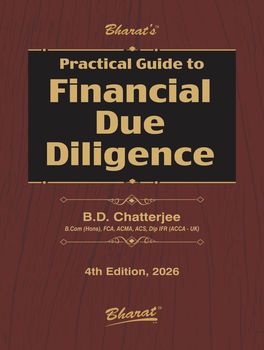
Practical Guide to Financial Due Diligence (4th Edition, 2026)
- Year of Publication: 2026
- Edition: 4th
- ISBN: 978-93-47779-59-6
- No.of Pages: 1065
In an era defined by accelerated global integration, expanding regulatory expectations, and unprecedented technological disruption, financial due diligence has evolved from a compliance formality into a strategic intelligence exercise. It is no longer sufficient to “review the numbers”. The modern deal environment demands a diagnostic lens capable of assessing business resilience, governance maturity, sustainability, and future value creation. The Practical Guide to Financial Due Diligence (fourth edition) is written to empower practitioners with such a lens. It brings together decades of corporate leadership, transaction advisory experience, regulatory insight, and operational exposure into a structured, field-tested methodology that speaks to real-world deal making — where decisions must be made quickly, often with imperfect information, and always with significant value at stake. It blends financial rigour with strategic insight, analytics with professional skepticism, and practical tools with governance discipline. This book is crafted to answer not only how to conduct financial due diligence, but why each step matters, what questions to ask, how to interpret red flags, and how to integrate findings into valuation, negotiation, and post-merger planning.
Structure and Flow of the Book
The twenty chapters follow a purposeful progression that mirrors the end-to-end diligence life-cycle:
Part I — Foundations of Corporate Restructuring & Transactions
- Chapters 1 to 3 set the conceptual and legal base: corporate restructuring pathways, M&A frameworks, and the statutory ecosystem governing transactions. They establish why due diligence is central to restructuring integrity and stakeholder protection.
Part II — Core Due Diligence Methodology
- Chapters 4 to 7 explain the due diligence approach — from scoping and workstreams to seller-side and buyer-side dynamics.
- This section integrates strategy, business processes, and operational realities, highlighting how financial due diligence must align with the commercial intent of a transaction.
Part III — Deep-Dive Financial Diagnostics
- Chapters 8 to 13 form the analytical heart of the book. These chapters dissect financial statements line-by-line, covering assets, liabilities, profitability, cash flows, working capital, contingencies, and financial health ratios with a forensic perspective.
- The focus is on identifying irregularities, sustainability indicators, value leakages, fraud symptoms, and accounting policy red flags.
Part IV — Risk, Valuation, and Distress
- Chapters 14 to 16 integrate financial risk management, valuation frameworks, and distressed-deal considerations into due diligence. This section connects analytical findings directly to transaction pricing, deal structuring, and negotiation leverage.
Part V — Emerging and Sector-Specific Diligence Dimensions
- Chapter 17 explores the rising importance of ESG in dealmaking, demonstrating how sustainability metrics, stakeholder expectations, and regulatory disclosures influence financial assessment.
- Chapter 18 extends the framework to industry-specific risk patterns — manufacturing, FMCG, healthcare, retail, infrastructure, start-ups, and more — ensuring sector relevance and practicality.
Part VI — Technology, Analytics, and Real-World Application
- Chapter 19 brings financial due diligence into the digital age through artificial intelligence, predictive analytics, automation workflows, and AI-enabled risk dashboards.
- Chapter 20 consolidates knowledge through case studies that illustrate real-life complexities, professional judgment, and practical application.
- Annexure I offers comprehensive due diligence checklists and questionnaires — ready-to-use tools for engagements.
This guide has been crafted to serve a wide and diverse audience: CFOs and Controllers; Private Equity, Venture Capital, and Corporate Development teams; Transaction Advisors, Consultants, and Valuation Professionals; Auditors and Assurance Teams; Students, researchers, and finance enthusiasts.
B D Chatterjee is a finance leader with CA, CMA, CS and Dip IFR (UK) qualifications having 35 Years rich experience in overall business and finance function.
He possesses expertise in CFO solutions having specialization in areas which include commercial accounting and audit, management accounting and MIS, developing budget and business plan and implementing budgetary control, business strategy and structuring and business valuation, financial management and debt syndication through banks and financial institutions.
He has rich experience in Mergers & Acquisitions including financial due diligence and handling negotiations between investors and target companies, managing implementation of many ERP projects in SAP and Navision, including change management and re-engineering of business processes.
He has handled many high profile leadership positions like CFO/VP/Director Finance assignments in global MNCs (BOC Gases, DuPont, Kelly Services) and large Indian conglomerates (Mother Dairy group, Max India) and possesses years of experience in industries like industrial gases, engineering polymers, agro chemicals, FMCG and dairy products, health care and manpower services among others. Currently he is associated with an International Think Tank as their Global CFO.
Apart from his consulting assignments, he has also authored books on Corporate Financial Reporting, Corporate Governance, Risk Management, International Financial Reporting Standards (IFRSs), Indian Accounting Standards (Ind ASs) and Business Valuation to name a few.
Bharat is a 'trade-name' for a group of concerns, popularly known as Bharat Law House and Bharat Law House Pvt. Ltd. Bharat is one of the most reputed publishers of law books with an experience of over six decades. It possess a very diverse range of publications covering not only the area of taxation - direct and indirect - but also company law, insolvency capital market, finance, industrial law, foreign exchange, commercial, civil and criminal laws. The students publications for CA, CS, CMA, CFA, MBA, graduate and post-graduate studies have carved out a niche for themselves. The Publication House has a professionally qualified team with strong in-house capabilities. Their strength lies in the patronage of legal luminaries in every field. They strive for accuracy, authenticity and sincerity.
Similar Books
Ratings and Reviews
Overall Rating
- Year of Publication: 2026
- Edition: 4th
- ISBN: 978-93-47779-59-6
- No.of Pages: 1065
In an era defined by accelerated global integration, expanding regulatory expectations, and unprecedented technological disruption, financial due diligence has evolved from a compliance formality into a strategic intelligence exercise. It is no longer sufficient to “review the numbers”. The modern deal environment demands a diagnostic lens capable of assessing business resilience, governance maturity, sustainability, and future value creation. The Practical Guide to Financial Due Diligence (fourth edition) is written to empower practitioners with such a lens. It brings together decades of corporate leadership, transaction advisory experience, regulatory insight, and operational exposure into a structured, field-tested methodology that speaks to real-world deal making — where decisions must be made quickly, often with imperfect information, and always with significant value at stake. It blends financial rigour with strategic insight, analytics with professional skepticism, and practical tools with governance discipline. This book is crafted to answer not only how to conduct financial due diligence, but why each step matters, what questions to ask, how to interpret red flags, and how to integrate findings into valuation, negotiation, and post-merger planning.
Structure and Flow of the Book
The twenty chapters follow a purposeful progression that mirrors the end-to-end diligence life-cycle:
Part I — Foundations of Corporate Restructuring & Transactions
- Chapters 1 to 3 set the conceptual and legal base: corporate restructuring pathways, M&A frameworks, and the statutory ecosystem governing transactions. They establish why due diligence is central to restructuring integrity and stakeholder protection.
Part II — Core Due Diligence Methodology
- Chapters 4 to 7 explain the due diligence approach — from scoping and workstreams to seller-side and buyer-side dynamics.
- This section integrates strategy, business processes, and operational realities, highlighting how financial due diligence must align with the commercial intent of a transaction.
Part III — Deep-Dive Financial Diagnostics
- Chapters 8 to 13 form the analytical heart of the book. These chapters dissect financial statements line-by-line, covering assets, liabilities, profitability, cash flows, working capital, contingencies, and financial health ratios with a forensic perspective.
- The focus is on identifying irregularities, sustainability indicators, value leakages, fraud symptoms, and accounting policy red flags.
Part IV — Risk, Valuation, and Distress
- Chapters 14 to 16 integrate financial risk management, valuation frameworks, and distressed-deal considerations into due diligence. This section connects analytical findings directly to transaction pricing, deal structuring, and negotiation leverage.
Part V — Emerging and Sector-Specific Diligence Dimensions
- Chapter 17 explores the rising importance of ESG in dealmaking, demonstrating how sustainability metrics, stakeholder expectations, and regulatory disclosures influence financial assessment.
- Chapter 18 extends the framework to industry-specific risk patterns — manufacturing, FMCG, healthcare, retail, infrastructure, start-ups, and more — ensuring sector relevance and practicality.
Part VI — Technology, Analytics, and Real-World Application
- Chapter 19 brings financial due diligence into the digital age through artificial intelligence, predictive analytics, automation workflows, and AI-enabled risk dashboards.
- Chapter 20 consolidates knowledge through case studies that illustrate real-life complexities, professional judgment, and practical application.
- Annexure I offers comprehensive due diligence checklists and questionnaires — ready-to-use tools for engagements.
This guide has been crafted to serve a wide and diverse audience: CFOs and Controllers; Private Equity, Venture Capital, and Corporate Development teams; Transaction Advisors, Consultants, and Valuation Professionals; Auditors and Assurance Teams; Students, researchers, and finance enthusiasts.
B D Chatterjee is a finance leader with CA, CMA, CS and Dip IFR (UK) qualifications having 35 Years rich experience in overall business and finance function.
He possesses expertise in CFO solutions having specialization in areas which include commercial accounting and audit, management accounting and MIS, developing budget and business plan and implementing budgetary control, business strategy and structuring and business valuation, financial management and debt syndication through banks and financial institutions.
He has rich experience in Mergers & Acquisitions including financial due diligence and handling negotiations between investors and target companies, managing implementation of many ERP projects in SAP and Navision, including change management and re-engineering of business processes.
He has handled many high profile leadership positions like CFO/VP/Director Finance assignments in global MNCs (BOC Gases, DuPont, Kelly Services) and large Indian conglomerates (Mother Dairy group, Max India) and possesses years of experience in industries like industrial gases, engineering polymers, agro chemicals, FMCG and dairy products, health care and manpower services among others. Currently he is associated with an International Think Tank as their Global CFO.
Apart from his consulting assignments, he has also authored books on Corporate Financial Reporting, Corporate Governance, Risk Management, International Financial Reporting Standards (IFRSs), Indian Accounting Standards (Ind ASs) and Business Valuation to name a few.
Bharat is a 'trade-name' for a group of concerns, popularly known as Bharat Law House and Bharat Law House Pvt. Ltd. Bharat is one of the most reputed publishers of law books with an experience of over six decades. It possess a very diverse range of publications covering not only the area of taxation - direct and indirect - but also company law, insolvency capital market, finance, industrial law, foreign exchange, commercial, civil and criminal laws. The students publications for CA, CS, CMA, CFA, MBA, graduate and post-graduate studies have carved out a niche for themselves. The Publication House has a professionally qualified team with strong in-house capabilities. Their strength lies in the patronage of legal luminaries in every field. They strive for accuracy, authenticity and sincerity.
